Dialogue between BAIC Liu Yu and Huawei Wang Jun: Intelligently breaking the order, the OEM should find a good brand positioning.
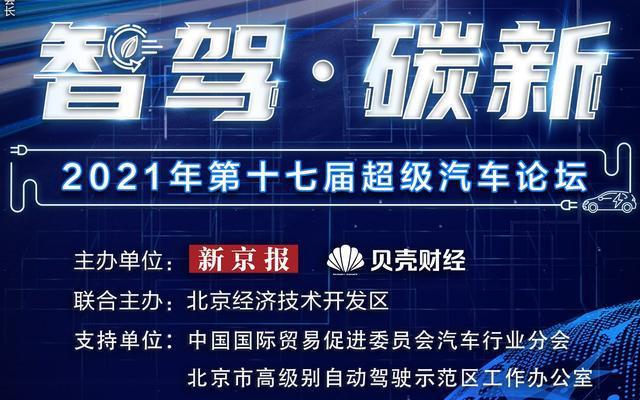
On January 20th, the 17th Super Car Forum in 2021, sponsored by Beijing News Shell Finance and co-sponsored by Beijing Economic and Technological Development Zone, was officially held. At the forum, Liu Yu, deputy general manager of BAIC Group, had an in-depth talk with BU COO Wang Jun, Huawei’s smart car solution. In the past two or three years, BAIC and Huawei have carried out in-depth cooperation on the polar fox brand, and the first landing achievement is in full swing.
Liu Yu said that in the future, the company will release more products equipped with Huawei HI solutions at the auto show. By the second half of 2022, the problem of "lack of core" may be alleviated. Robotaxi (driverless taxi) aims to solve the problem of timely, fast, convenient and reasonable cost travel for consumers, which will bring great challenges to the taxi and online car rental industries. Intelligentization has broken the original order, and independent brands also have a certain ability to overtake in corners. With the advent of the era of smart cars, the future OEM should find a good positioning in the brand.
In the conversation, Wang Jun reiterated that Huawei does not build cars, and the core is to help enterprises build good cars. After the whole supply system is more orderly, the shortage of chips will no longer be a problem. Only by realizing unmanned driving can we subvert the current state of the entire automobile industry. In the future, the application of automobiles in intelligent driving, intelligent cockpit, etc. must be common and new. As a component supplier, Huawei hopes to help its partners improve at all stages of the entire industrial chain and finally achieve commercial success.
Jihu HuaweiHIThe version of the model is being prepared for scale delivery, and Huawei reiterates that it will not build a car.
Liu Yu revealed in the dialogue that at present, the HUAWEI HI version of ARCFOX αS, a subsidiary of BAIC Extreme Fox, is in full swing to prepare for the scale delivery, and some users who have obtained the internal invitation code have started the road test. In the future product planning, Liu Yu said that enterprises will apply Huawei’s HI product solutions to more products. In the future, Polar Fox may apply high-level assisted driving, high performance and high charging efficiency technologies to smaller products. The next generation of products is planned to be announced at Beijing Auto Show and Guangzhou Auto Show.
According to Liu Yu, Huawei HI version of the polar fox ARCFOX αS has a high level of assisted driving. The product was officially established in 2018 and officially unveiled at the Shanghai Auto Show in April 2021. According to previous news, Huawei HI version of ARCFOX αS will be delivered at the end of 2021, but it has been delayed for technical reasons.
Wang Jun also confirmed that Huawei HI version of ARCFOX αS is being delivered in a sprint. He pointed out that this marks the landing of a fruit of deep cooperation between the two sides. Previously, Huawei had reached in-depth cooperation with BAIC, Changan and Guangzhou Automobile. Wang Jun said that in the future, this kind of cooperation will not be too much, because this kind of cooperation will consume a lot of resources of Huawei. At present, Huawei still hopes to focus on these car companies that have already cooperated and support their cars.
During the dialogue, Wang Jun also reiterated that "Huawei does not build cars". "Otherwise, I wouldn’t be able to sit here with President Liu today and discuss these topics." Wang Jun said, "Our core is to help enterprises build good cars".
Liu Yu said that the teams of Polar Fox and Huawei will provide a high-level assisted driving scheme for the ARCFOX αS Huawei HI Edition in compliance with the road regulations of China. The technical strength of this solution may even be really off-hand, off-foot and off-eye. At the end of November and the beginning of December, 2021, polar fox has launched internal testing for the product. Some users who have got the internal invitation code have started to do tests, help catch bugs and make comments. Liu Yu believes that the products delivered to users can be "not afraid" of courier brothers and small animals crossing the road in high-level assisted driving functions.
The sales volume of polar fox will reach this year.30 thousand -4Ten thousand vehicles, chip supply may be eased in the second half of the year.
When talking about car sales, Liu Yu said that Beiqi Blue Valley has given up the restrictions of taking sales as the leading factor, controlling costs and reducing consumers’ experience as the leading factor, and taking new technology, high quality and solutions that exceed consumers’ expectations as the leading direction in electric vehicles, so the sales performance fluctuated.
However, Liu Yu said that in 2021, new energy vehicles have achieved nearly 3 million insurance coverage, the market share is rising, and the era of 30% is coming soon. For the fox, 2022 will be a period of great development, and the brand sales will reach 30,000-40,000, or even higher. Of course, the specific sales volume depends on the supply chain, and the supply of chips is also a "very headache". He predicted that perhaps the problem of "lack of core" will be alleviated in the second half of 2022.
In contrast, Wang Jun is more optimistic about the supply of chips. He pointed out that the solution to the "chip shortage" is actually the transformation process of the supply system from disorder to order. The demand for chips in the whole automobile industry is not an order of magnitude compared with the demand for chips in consumer goods, and the shortage of production capacity, such as the suspension of production in factories due to epidemic situation, is only phased. Now, from the perspective of production capacity alone, there is no problem. The real problem is that after the shortage, it triggered a disorderly run. After the whole supply system is more orderly, the shortage of chips will no longer be a problem.
Previously, Yu Chengdong, managing director of Huawei, consumer BG CEO and smart car solution BU COO, proposed that Huawei would challenge the goal of selling 300,000 vehicles this year. In this regard, Wang Jun said that nothing is impossible, and this matter depends on two points. The first is whether the product is good enough and whether the end user will really pay the bill; The second is whether the sales channel is strong enough and perfect enough to sell good products. "I think if we do these two things, everything can be achieved." Wang Jun said.
Liu Yu also said that the development trend of intelligent vehicles based on new energy products is limitless, and the sales of 200,000 vehicles and 300,000 vehicles are just around the corner. Liu Yu believes that all Huawei’s new products are developed based on electrification and intelligence, and actions that fully conform to the general trend are implemented. Therefore, he feels that it is just around the corner to sell 200,000 vehicles and 300,000 vehicles a year. Even in the near future, the streets and alleys will be new energy vehicles.
Software-defined cars will reconstruct the cockpit ecology, and Robotaxi will bring challenges to the taxi network car industry.
When talking about the topic of "software-defined car", Wang Jun said that what the future car will look like depends on whether the real driverless technology can be realized. Only by realizing unmanned driving can we subvert the current state of the entire automobile industry. "If driverless driving can’t be realized, I think the car will still be just the car now." Wang Jun said.
Wang Jun pointed out that Huawei experts predict that real driverless driving may be realized in the next 5-10 years. At that time, the intelligent cockpit will be designed around the driver and passengers, and many subversive technologies will be used in the cockpit, which involves a complex ecosystem. In addition to the field of intelligent driving, Huawei has also invested a lot in the intelligent cockpit. "With the Kirin module and HarmonyOS operating system, we hope to create a HarmonyOS space in the cockpit, and apply more and more partners’ new technologies and products to the cockpit more quickly through ecology. This is what’ software-defined cars’ really want to achieve. " Wang Jun said.
Wang Jun said that if unmanned driving is realized, Robotaxi will be a very big market, which will change the way people travel as a whole. With the change of travel mode, the change of payment mode will also be a matter of course.
Liu Yu pointed out that Robotaxi is more about solving the problem of timely, fast, convenient and reasonable cost travel for consumers, which will bring great challenges to the taxi and online car rental industries. But this is not exactly the same as the way that private cars solve personal travel, personalized travel, and even create a third space.
In Liu Yu’s view, for consumers, some people will choose a convenient and efficient way to travel, but the car is a high-speed moving space. With the more application and popularization of autonomous driving technology, this space will have more unlimited imagination. To a certain extent, the self-driving RV may become people’s residence in the future, bringing more interesting life scenes in the future. Liu Yu believes that in such a situation, vehicles will become a personalized personal space, and personalization will replace generalization, and products will meet the diverse and differentiated needs of consumers. This may be a bifurcation point in the application of autonomous driving.
Intelligence breaks the original order of the industry, and the iterative speed of automobiles is greatly accelerated.
When discussing the challenges brought by the intelligent development of automobiles, Liu Yu bluntly said: "Intelligence has broken the original order." On the one hand, China automobile brands have the strength to challenge international automobile manufacturing enterprises through new technologies and new application scenarios; On the other hand, many original boundaries have been broken, and the iteration speed of automobile products has been shortened from 40-50 months to 12-15 months.
Liu Yu said that in the past, China’s automobile industry was still somewhat backward compared with international big-name enterprises in terms of technologies such as internal combustion engines. However, with the emergence of new technical routes and new application scenarios, every China enterprise has the strength to challenge international automobile manufacturing enterprises. "We can see that some joint ventures are gradually withdrawing from the China market, and their output and profits are shrinking on a large scale. We can even see that even in the business field of fuel engines, many independent brands have surpassed joint venture brands in sales volume and profit. " Liu Yu bluntly said.
At the same time, Liu Yu mentioned that the intelligent era has broken many original boundaries. In the cooperation with Huawei, unlike in the past, the two sides can not clearly define the business model of cooperation, and can only call it HI business model. In this mode, both sides almost have you and me, and work hard for a common goal.
In Liu Yu’s view, due to the application of more new technologies in smart cars, the iterative speed of products has also changed greatly. In the past, the product iteration cycle in the automotive industry was 40-50 months, but it was only about 18 months in the ICT industry. After the collision of ideas between the two sides, according to the needs of consumers, it is found that the software can be updated once every three months, and the hardware of electronic appliances can be updated once every 12-15 months, which is a big impact on the traditional automobile manufacturing industry. If we insist on the long-term development speed, the brand is likely to be eliminated by the times soon.
Wang Jun also agrees that in the stage of the integration of technology and automobile industry, the trend of intelligence is gradually accelerating, the application is becoming more and more common, and the iteration cycle of automobile products is getting faster and faster. If it is used in intelligent driving, intelligent cockpit and other aspects, it must be common and new, which will be realized by software OTA or even changing the computing platform. At present, Tesla and other car companies are doing this work. I believe that more and more car companies will think and practice in this area in the future, which will become a common behavior.
However, Wang Jun also pointed out that the length of the iteration cycle is also divided into different parts. If it is the lower body of a car, including powertrain and other parts, the update will not be so fast, and a larger safety cycle is needed.
Independent brands have a certain overtaking ability in corners, and joint venture brands will face challenges.
Liu Yu pointed out in the dialogue that new energy vehicle technology has entered a stable period. If there is no shortage of chips and batteries in 2022, the sales volume of new energy vehicles will exceed 5 million, and some independent brands have already had the ability to overtake in certain corners.
In Liu Yu’s view, the current three-point technology of electric vehicles has reached a platform period, and it has reached a stable period in terms of safety, endurance performance and cost. The cruising range of electric vehicles is 700km and 800km. Even in the north, the cruising performance is very good. Combined with the continuous laying of infrastructure, consumers’ anxiety and concern about buying and using new energy vehicles are greatly reduced.
Liu Yu mentioned that the accelerated performance, use cost and maintenance cost of electric vehicles have a good performance compared with fuel vehicles, and the application of more new technologies has mushroomed in new energy vehicles. Although the China market is still dominated by joint ventures, joint ventures will occupy more market share, and independent brands still rely on relatively low prices and cheap technical routes to compete. However, in the new energy automobile industry, except Tesla, most of the leading enterprises in the market are independent brands. This means that China has the ability to overtake in certain corners from the OEM to the supply chain, to the definition of the whole product and to the creation of user experience.
Liu Yu said that the accumulation of core technologies of independent brands, the speed of product iteration and the matching of consumer demand are all rapidly improving, and joint venture brands will face great challenges.
The OEM should find a good position in the brand, and Huawei hopes to seek a win-win situation through cooperation.
Liu Yu pointed out that with the advent of the era of smart cars, OEMs should find a good position in the brand in the future. In Liu Yu’s view, the brand has a long period of precipitation, which can make consumers feel, taste and meet the needs of consumers in a certain field.
Liu Yu said that there are 60-80 million new cars growing every year in the world, but no other single brand can break through the sales of 10 million cars except Toyota. Mercedes-Benz and BMW, both luxury brands, have been competing for 100 years, but no one has completely defeated anyone. This shows from the side that the needs of consumers are different, which also produces different brand series.
Wang Jun also said that in the future, there will not be only a few brands left in the automobile field, as in the mobile phone field, because the single value of automobiles is relatively large, the decision-making cycle of users is relatively long, and the industry is regional and closely related to the policy direction. It is a very complex comprehensive industry, and there will be many brands in the future.
Liu Yu believes that in this state, OEMs should still provide distinctive service solutions according to their dreams of building cars and consumer needs. If you want fast products, you must give up space to ensure the wind resistance coefficient; If you choose a product with a large space, your driving performance will be relatively weakened. If someone wants a product with high speed, large space and low cost, it doesn’t exist. Therefore, OEMs should grasp a balance, and consider which application scenario or interface the brand is willing to communicate with consumers, and what kind of solutions to provide, which will have a lot of imaginable space.
Wang Jun, on the other hand, said that OEMs will start with the brand and product definition, and build the supply chain, the basic quality of the whole vehicle, and the reputation of sales and service. The OEM has many unique values to support the sustainable development and operation of the brand.
As a component supplier, Huawei hopes to help its partners improve at all stages of the entire industrial chain and finally achieve commercial success. "The OEM can realize its commercial value. We sold our parts, and naturally our commercial value has also been rewarded. This process is win-win." Wang Jun said.
Beijing News Shell Finance reporter promised Bai Haotian editor Xu Chao proofread Liu Jun.
Reporting/feedback