New york Times CNN’s careful machine has finally been noticed by Americans.
[Compile/Observer Network Guo Han]
An independent organization in the United States that monitors media news reports found that although street demonstrations occurred frequently around the world this year, the mainstream media in the United States "took extra care" of Hong Kong and spared no effort to favor the demonstrators and ignore the violence they created.
On December 6th, an American non-profit organization named FAIR revealed that compared with other countries and regions, the mainstream media in the United States used a disproportionate amount of space to report the demonstrations in Hong Kong.
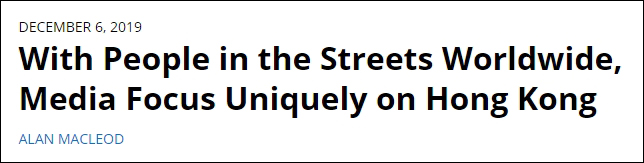
Screenshot of FAIR website "When people all over the world take to the streets, the (American) media only pay attention to Hong Kong"
The organization was founded in 1986, headquartered in new york, with a left-wing position. Its goal is to supervise the accuracy, bias and audit of American media reports, and call for the split of large media companies.
The article believes that these media companies build a stereotype by reporting a lot and covering up the shady details of the demonstrators, that is, "a group of Hong Kong people who are democratic are fighting Beijing for freedom."
Therefore, this paper counts the number of times that The New York Times and CNN reported street demonstrations in Hong Kong, China, Ecuador, Haiti and Chile. These two media are chosen because they are the most representative and good at setting the agenda in print and TV media.
Since the start time of protests in different countries and regions is different, it ends on November 22, 2019 statistically. The reporting time on Hong Kong lasted for eight months, from October when protests broke out in Ecuador and Chile to July last year in Haiti.
As far as the total number is concerned, the two media reported 737 articles on Hong Kong (325 in New Times and 412 in CNN), 12 in Ecuador, 28 in Haiti and 36 in Chile. The number of reports on Hong Kong is nearly 10 times that of other topics.
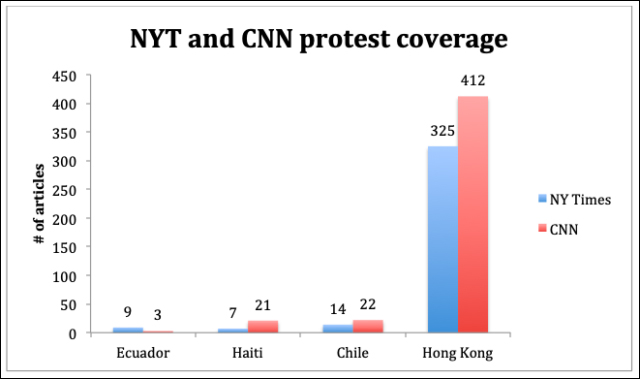
The New York Times and CNN reported on the demonstrations in the Hong Kong Special Administrative Region far more than the screenshots of other countries and regions:FAIR
Although the duration of demonstrations in different regions is different, it is impossible to generalize, but comparing the reports in the same period can still support this conclusion.
For example, October 3-14 is the most intense period of street protests in Ecuador. During the period,"New Time" only published 6 related reports, and CNN3 articles; However, the two media reported 33 and 38 articles on Hong Kong respectively in the same period.
Since the demonstration broke out in Chile on October 4,New Time and CNN reported 14 times and 22 times respectively; In the same period, there were 59 and 92 reports on Hong Kong respectively.
It must be pointed out that many reports on the demonstrations in the above three countries are classified as "protests around the world", and sometimes only one or two sentences are mentioned in each article. CNN has only two special reports on Ecuador, and half of its reports on Haiti are concerned about the impact of demonstrations on American citizens.
But when it comes to Hong Kong, most of them are long exclusive reports. This has not included articles such as demonstrations affecting Asian stock markets.
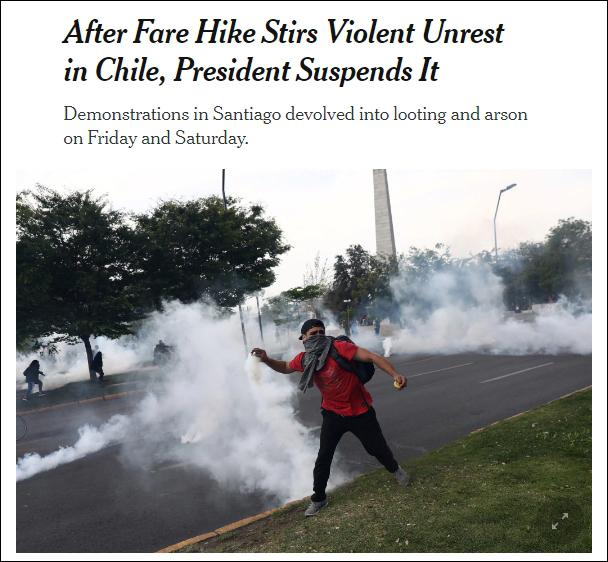
New york’s report on street demonstrations in Chile with photo: Reuters
On the other hand, the difference in the number of reports between Hong Kong and the other three countries is so obvious that it cannot be understood according to the scale of the protests or the degree of the means of maintaining stability by powerful departments.
For example, a week after the demonstration, eight people have died in Ecuador. The United Nations has confirmed that 42 people have been killed in protests in Haiti in the past two months. Chilean right-wing President Piniella simply sent tanks to the streets, and the military arrested more than 26,000 people, during which 26 people died.
In contrast, no one died because of the law enforcement of the Hong Kong police. Over the past six months, a student accidentally fell off the building, and another 70-year-old cleaner, Rob, was hit by a stone from a demonstrator and died unfortunately.
When reporting on Hong Kong, the language of the two media is also very "Be particularThe negative words used to describe demonstrators in Ecuador, Haiti and Chile are rarely used in Hong Kong. And we should highlight the so-called "democratic" characteristics of the latter and ignore its violent behavior.
For example, CNN reported on August 30 and October 15, and New Times reported on October 15 and November 21, all of them described the thugs who created violence and destruction on the streets of Hong Kong as "pro-democracy demonstrators".
However, street demonstrators in Chile who have similar behaviors have become "robbery and arson" and "riots" in the mouth of the two media. "Violent demonstrations swept through Quito (the capital of Ecuador) … The demonstrators took military members hostage."

Screenshot The New York Times
The article points out that even if it is actually very appropriate, such words are rarely used in Hong Kong’s demonstrators. Apart from causing damage, they even lit gasoline on a dissident citizen in broad daylight, leaving him in a coma for 10 days.
In a report on November 17th, The New York Times used a passive tone to lightly describe that a police officer was shot in the leg by a mob bow and arrow, and did not forget to emphasize that "the demonstrators were’ resisting’ the police attack’".
Even after reporting that mobs made and intended to use "hundreds of incendiary bombs", the newspaper still called them "pro-democracy activists" in the article.
On October 17, CNN also announced a gas tank-sized mob homemade bomb, and got news that they planned to attack the police with it. The shape of this bomb is very similar to the bomb used in the Boston Marathon bombing in 2013.
The article questioned whether CNN and New Times would continue to call them "pro-democracy activists" if members of organizations such as "Black Life Expensive" and "Antifa" used such bombs to attack the police.
This article is an exclusive manuscript of Observer. It cannot be reproduced without authorization.