[Enough Science] World Water Day: Healthy Water Use to Prevent Diseases
Cctv news(Reporter Pan Cong Zhang Ke Yi, correspondent Shi Liang, produced.
Lu Yuanyuan): Schistosomiasis, also known as plague god, is one of the major infectious diseases that seriously endanger people’s physical and mental health and affect economic and social development. Once the human body is infected with Schistosoma japonicum, it will appear rash, fever, cough or accompanied by abdominal distension, diarrhea or bloody stool. If it is not treated, it will lead to a large number of patients’ illness and even death. The World Health Organization believes that schistosomiasis is a neglected parasitic disease, which brings a lot of public health problems to Africa, Asia, the Caribbean, South America and subtropical regions. About 779 million people in the world are at risk of infection, and at least 236.6 million people need preventive treatment for schistosomiasis in 2019.
As a water-borne disease, in the 1950s, the Party and the government attached great importance to the prevention and control of schistosomiasis, and led the broad masses of people to carry out arduous struggles. At present, the prevalence of schistosomiasis has dropped to the lowest level in history. However, as long as the only intermediate host of Schistosoma japonicum — — When snails exist, the risk of schistosomiasis transmission still exists.
From a professional point of view, Oncomelania hupensis the only intermediate host of Schistosoma japonicum, and it is an amphibious snail. More than 40 kinds of mammals, such as human, cattle, sheep, cats and dogs, will excrete their eggs with feces after being infected with Schistosoma japonicum. When the eggs meet with water, they will hatch into cercaria, which will further develop into cercaria. People will be infected with Schistosoma japonicum when they come into contact with water containing cercaria (medically called epidemic water).
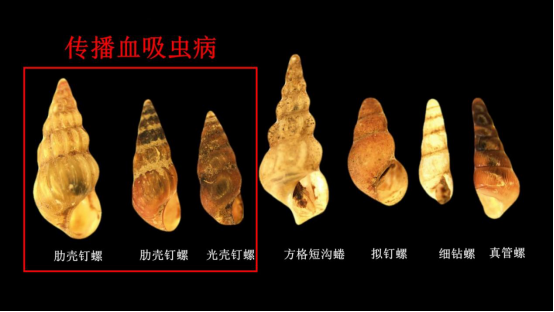
Comparison of Oncomelania hupensis and similar snails
What is the biggest difference between snails and snails we eat and play with? Xiong Chunrong, an attending physician in the Schistosomiasis Department of Jiangsu Institute of Schistosomiasis Control, said that snails are conical in shape and can be divided into two types: one is called ribbed snails with longitudinal ribs on the shell surface, and the length is generally about 10 mm; Another kind of snail with smooth surface and no longitudinal ribs is called light shell snail, and its length is generally less than 7 mm. Xiong Chunrong said that there are two ways to identify snails quickly and efficiently: first, local experts can be invited to help identify them through the local CDC; In addition, you can use mobile phone software — — AI intelligent snail recognition WeChat applet for photo-assisted identification.
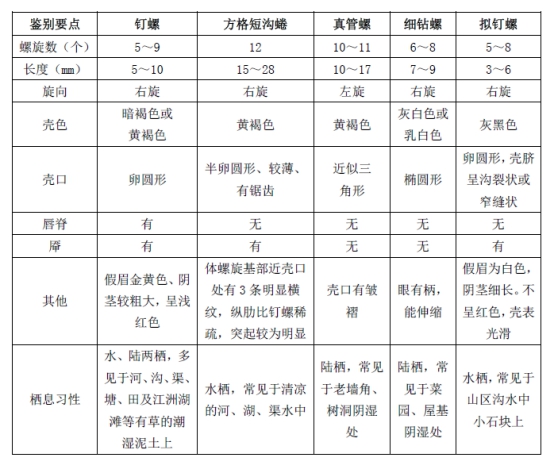
Key points of distinguishing Oncomelania hupensis from similar snails (Source: People’s Republic of China (PRC) Health Industry Standard WS/T 563— 2017 Oncomelania survey)
Oncomelania hupensis widely distributed in twelve endemic provinces in China. It is possible to spread schistosomiasis in the water source environment of the epidemic area where snails breed. When the human body is exposed to the epidemic water for 8 seconds, cercaria burrows into the skin, and people are infected with Schistosoma japonicum, which matures in the body for about 1 month. How to achieve early detection and early treatment? Zhang Jianfeng, deputy director of the Schistosomiasis Department of Jiangsu Institute of Schistosomiasis Prevention and Control, said that people are easy to get infected with schistosomiasis when they carry out activities such as water work, flood control and fighting, washing clothes and vegetables, swimming and swimming in rivers, lakes, rivers and ponds where snails breed. If you have skin rash, fever, cough or symptoms such as abdominal distension, diarrhea, purulent bloody stool after contact with infected water in schistosomiasis endemic areas, please go to a medical institution or CDC for medical treatment in time, and take the initiative to inform the doctor about contact with infected water. Schistosomiasis is caused by human contact with infected water. Therefore, avoiding or reducing contact with infected water is the most effective way to prevent schistosomiasis. When contact with epidemic water is inevitable in production and life, rubber boots or protective water pants should be worn before entering the water, latex gloves should be worn, and protective cream should be evenly applied to the parts of the body that contact with epidemic water. These measures can greatly reduce the probability of schistosomiasis infection.
With the economic globalization and the accelerating pace of China’s opening to the outside world, people who go abroad to work, build aid, do business, study and travel often find schistosomiasis abroad. Schistosomiasis is endemic in 78 countries, mainly in African countries. Among them, the average infection rate of schistosomiasis in Tanzania is as high as 20%
.
How should outbound personnel prevent schistosomiasis? Yang Kun, deputy director of Jiangsu Institute of Schistosomiasis Control and head of China’s schistosomiasis control project in Zanzibar, Tanzania, said that before departure, people going abroad should be given health education to improve their awareness of prevention, change their bad living habits and avoid contact with infected water. Because it is difficult to avoid contact with epidemic water because of work needs, you can apply protective cream, wear rubber shoes or protective water pants and latex gloves before work to avoid direct exposure of skin to water. After contact with epidemic water in an emergency, artesunate and artemether can be taken to prevent or treat schistosomiasis infection. The employer regularly organizes personnel to carry out physical examination, so as to achieve early detection and early treatment. (Proofreading
Chen Yanhui)